.jpg)
Ultimate Guide to Heritage Masonry Repointing: Tools, Techniques, and Mortars for Preserving BC’s Historic Structures

While it sounds cliche, heritage masonry repointing is both an art and science that breathes new life into aging stone and brick structures, ensuring they withstand time while retaining their historical character and integrity. In British Columbia, where coastal climates accelerate mortar deterioration through salt air and heavy rains, repointing is essential for preserving landmarks like Victoria’s Victorian homes in James Bay or sandstone buildings in Duncan. This guide explores the fundamentals of repointing for heritage-designated properties, from selecting compatible mortars like traditional lime-based options to using specialized, heritage-approved tools such as the Trow and Holden mortar removal kit.
Whether you’re a homeowner in Oak Bay maintaining a century-old facade or a professional restorer complying with the Heritage Conservation Act (HCA), this resource provides step-by-step insights, best practices, and tips tailored to Vancouver Island’s unique environment. At Stone & Trowel Heritage Restoration, with over 75 years of combined expertise, we’ve repointed countless heritage sites, blending traditional techniques with modern sustainability. Drawing from provincial guidelines and hands-on experience, we’ll cover tools, mortars (including Hotlime/Quicklime), processes, and compliance strategies. By the end, you’ll have a roadmap to execute or oversee repointing projects that honor history and enhance longevity.
Contents
What is Heritage Masonry Repointing?
Discover the essentials of repointing: removing deteriorated mortar and replacing it with compatible materials to protect historic masonry. This section explains why it’s crucial for heritage structures in BC’s damp climate, preventing water damage and structural failure while maintaining authenticity.
Essential Tools and Equipment
Get familiar with specialized tools for safe, precise repointing. This section covers the Trow and Holden mortar removal kit, chisels, mixers, and safety gear essential for heritage projects in Greater Victoria.
Common Mistakes to Avoid
Identify pitfalls like using incompatible cement or over-raking joints, and how to prevent them in heritage contexts.
History and Importance in BC Heritage Conservation
Explore the evolution of repointing techniques from ancient lime-based methods to modern adaptations, and why it’s indispensable for BC’s heritage registry compliance. This section highlights how proper repointing safeguards cultural landmarks against coastal weathering.
Step-by-Step Repointing Process
This section provides a detailed walkthrough of repointing, from assessment to curing, incorporating tools like the Trow and Holden mortar removal kit and mortars such as Hotlime.
Case Studies: Successful Heritage Repointing Projects
Learn more about some of Stone & Trowel's heritage conservation projects in Victoria, BC and Vancouver Island, as well as the end-results and benefits of applying for grants through Heritage compliant organizations.
Types of Mortars for Heritage Repointing
Learn about mortar varieties suited for heritage work, emphasizing breathable, compatible options like lime-based mixes. This section details Hotlime/Quicklime applications, NHL mortars, and how to match originals for BC’s variable weather.
Best Practices and Repointing Tips
Master tips for flawless results: depth ratios, weather considerations, and tool maintenance. Incorporate Hotlime for wet applications and Trow and Holden for precision.
Frequently Asked Questions (FAQs)
Find quick answers to common questions about heritage masonry repointing techniques, mortars, and guidelines.

What is Heritage Masonry Repointing?
Heritage masonry repointing involves carefully removing old, failing mortar from the joints of stone or brick structures and replacing it with a new mix that matches the original in composition, color, texture, and strength. Unlike general masonry work, heritage repointing prioritizes minimal intervention to preserve the building’s historical fabric, adhering to standards like those in the Heritage Conservation Act and the Standards and Guidelines for the Conservation of Historic Places in Canada.
In BC, repointing is vital for combating environmental stressors: Vancouver Island’s persistent humidity and freeze-thaw cycles erode mortar, leading to cracks, efflorescence, and instability. For designated properties, repointing must comply with local bylaws—often requiring Heritage Alteration Permits (HAPs) to ensure no harm to cultural significance.
Key principles include using breathable mortars that allow moisture to escape, avoiding rigid modern cements that trap water and cause spalling. At Stone & Trowel, we assess each joint’s condition, matching profiles (e.g., concave, flush) to the original. This not only extends the structure’s life but also qualifies projects for incentives like tax exemptions under the Community Charter.
Repointing differs from pointing (initial joint filling) or tuckpointing (decorative enhancement). It’s a conservation technique, often part of broader restoration, ensuring heritage buildings like those in Victoria’s Rockland neighborhood remain intact and beautiful.
History and Importance in BC Heritage Conservation
The history of masonry repointing dates back to ancient civilizations, where lime mortars were used in Roman aqueducts and medieval castles for their flexibility and durability. In BC, early European settlers adopted these techniques for structures like Fort Victoria (1843), using local aggregates and lime from imported or regional sources. By the late 19th century, as Victoria boomed with brick and stone buildings, repointing became key to maintaining facades against Pacific Northwest rains.
The 1977 Heritage Conservation Act formalized repointing’s role in conservation, mandating compatible materials for designated sites to prevent “demolition by neglect.” Amendments in the 1990s integrated repointing into land-use planning, with tools like Heritage Revitalization Agreements (HRAs) rewarding compliant work.
Importance in BC: Poor mortar leads to 70% of heritage masonry failures, per Heritage BC studies. In coastal areas like Greater Victoria, salt-laden winds accelerate erosion, making repointing a frontline defense. It preserves aesthetic value, supports tourism (e.g., James Bay’s heritage walks), and qualifies for grants. Economically, well-repointed buildings increase property values by 15–20% in historic districts.
At Stone & Trowel, we draw on this history, using time-tested methods to ensure restorations like Duncan City Hall endure.
Types of Mortars for Heritage Repointing
Mortars for heritage repointing must mimic the original’s permeability and strength to avoid damaging the softer historic masonry. Key types:
1. Lime Mortars: Traditional choice for pre-1940s buildings. Made from slaked lime, sand, and water, they’re flexible and vapor-permeable, ideal for BC’s humid climate.
• Hotlime/Quicklime Mortars: Produced by burning limestone at high temperatures to create quicklime (calcium oxide), which is slaked with water to form hotlime putty. This “hot mix” sets through carbonation, offering superior adhesion and breathability. In Vancouver Island projects, hotlime excels in rainy conditions, resisting washout during application. We often use it for exposed facades, as it matures stronger over time without the rigidity of cement.
• Natural Hydraulic Lime (NHL) Mortars: Mildly hydraulic (sets with water), like NHL 2, 3.5, or 5. Suitable for moderately exposed areas; NHL 3.5 is common in Victoria for its balance of strength and flexibility but we typically stick to NHL 2 for most soft brick applications or mix a combination of NHL 2 with Quicklime when just a tad more strength is needed.
2. Portland Cement Blends: Rarely used alone in heritage work due to hardness; limited to low ratios (e.g., 1:2:9 cement:lime:sand) for high-exposure sites, but avoided to prevent cracking.
3. Pozzolanic Additives: Natural pozzolans like volcanic ash enhance lime mortars’ hydraulic properties for wetter climates.
Matching originals involves lab analysis (e.g., acid digestion tests) to replicate ratios, aggregates, and pigments. For BC registry compliance, use breathable mortars to meet HCA guidelines. Stone & Trowel sources local sands for authentic color matches, ensuring sustainability.

Essential Tools and Equipment
Effective repointing requires tools that minimize damage to historic masonry. Core essentials:
• Mortar Removal Tools: The Trow and Holden mortar removal kit is a staple—featuring carbide-tipped cape chisels, alongside mallets, and rakes designed for gentle joint clearing. Its precision blades allow controlled removal without chipping stones, ideal for delicate Victorian brick on old character homes in Victoria's James Bay region.
When raking out large joints between stones, we often use a Bosch Bulldog Extreme with variable speed and mortar removal chisels alongside a vacuum attachment.
• Chisels and Hammers: Plugging chisels (narrow for deep joints) and lump hammers for tapping; avoid power tools on fragile sites to comply with minimal intervention principles.
• Mixing Equipment: Paddle mixers for consistent lime mortars; avoid high-speed drills to prevent air bubbles. We typically use a combination of large rubber buckets in order to slake the Quicklime prior to transferring it to a large metal wheelbarrow for mixing with a perforated garden hoe.
• Application Tools: Pointing trowels (narrow, angled), hawk boards, and jointers for profiling.
• Cleaning Gear: DOFF Integra steam cleaners for residue removal; soft brushes and low-pressure rinses.
• Safety and Analysis: PPE (gloves, respirators), moisture meters, and pH testers to ensure mortar compatibility.
For BC heritage work, tools must support reversibility—Stone & Trowel uses the Trow and Holden mortar removal kit on 80% of projects for its heritage-friendly design.
Step-by-Step Repointing Process
1. Assessment: Inspect joints for depth (remove to 2–2.5 times width), test mortar type via lab or visual cues.
2. Preparation: Protect surroundings; use Trow and Holden tools to rake out old mortar carefully, avoiding undercutting.
3. Mortar Mixing: Prepare Hotlime/Quicklime mix (e.g., 1:3 lime:sand); slake quicklime safely with water for hot putty.
4. Application: Dampen joints with a wet sponge or spray bottle, apply mortar in layers with a hawk and jointer, tool to match original profile.
5. Finishing and Curing: Brush back/off excess mortar and use a churn brush to apply pressure to the joints, mist for slow carbonation (2–4 weeks).
6. Post-Work: Clean with a DOFF Integra steam cleaner, document for compliance.
Best Practices and Repointing Tips
• Match mortar strength to masonry (softer for heritage stone).
• Work in mild weather (5–25°C); use Hotlime for faster set times in the rain.
• Maintain and keep your tools sharp for clean cuts and removal.
• Test patches on inconspicuous areas.
• Integrate sustainability: Recycle aggregates, use low-VOC sealants.
• For coastal BC: Add pozzolans to resist salt.
Stone & Trowel tip: Always start with a lower psi on the Trow & Holden pneumatic hammers to test the softness/hardness level of the mortar prior to adjusting the air flow related to your compressor and the pneumatic hammer.
Common Mistakes to Avoid
• Mistake: Cement mortars—trap moisture, cause spalling.
• Fix: Stick to traditional lime-based mortars like Hotlime.
• Mistake: Power tools—damage edges. Never use grinders.
• Fix: Hand tools like mallets and chisels.
• Mistake: Rushing curing—leads to cracks.
• Fix: Mist regularly.
• Mistake: Ignoring permits—fines up to $50,000.
• Fix: Check registry pre-work.
Case Studies: Successful Heritage Repointing Projects
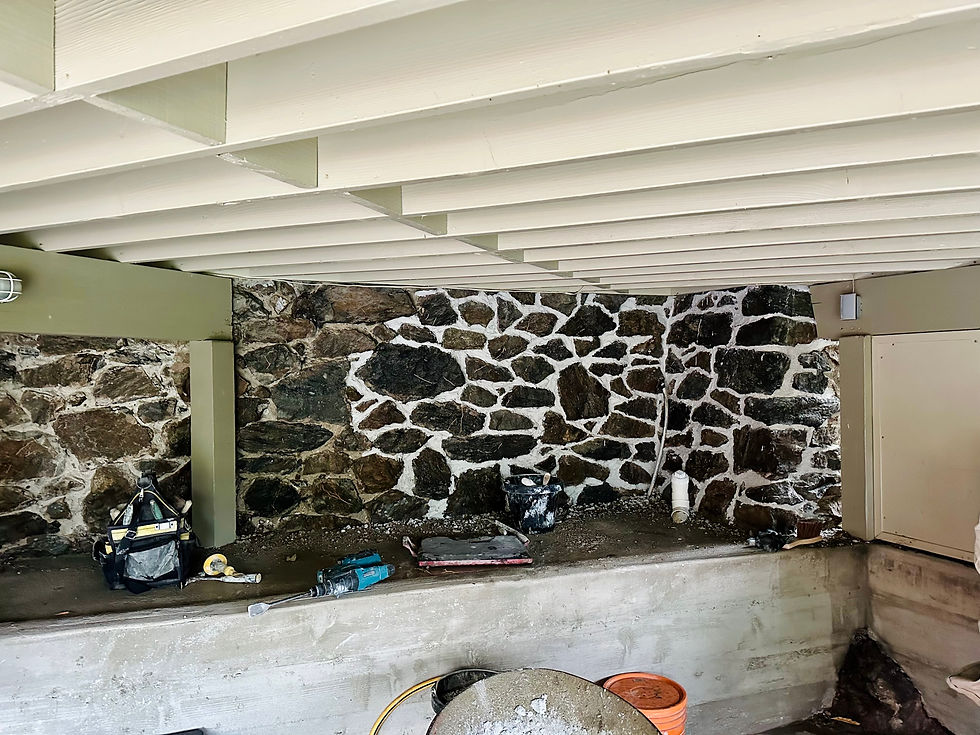
Case Study 1: Stone & Trowel's repointing of heritage granite walls at the Government House in Victoria, BC. This project entailed using hammers and chisels to remove mortar by hand, along with Trow and Holden's pneumatic hammer and cape chisels for harder sections. After testing, the walls were then repointed with a mixture of Hotlime and a Natural Hydraulic Lime 2.0 to replicate the original mortar used.
Result: These low-lying stone retaining walls will now continue to function properly for decades to come.
Case Study 2: Stone & Trowel's repointing of the sandstone belts around Duncan, BC's City Hall using traditional lime mortar (Hotlime) and lime-wash to reface the sandstone and protect it from weathering further.
Result: The sandstone will continue to hold the brickwork above in place and add structural stability to the city hall in general.

Case Study 3: Stone & Trowel's repointing of the sandstone features and granite stonework of the Porte Cochere at the Government House in Victoria's character filled, Rockland neighborhood.
Result: Structural integrity was reintroduced to the stonework as a whole and made safe for generations to follow.


Frequently Asked Questions (FAQs)
1. What’s the difference between Hotlime and Quicklime? - Quicklime is raw; Hotlime is slaked for safer use.
2. When to use Trow and Holden kit? - For precise, non-damaging removal in heritage joints.
3. How long does repointing last? - 50–100 years with proper materials.
4. Do I need a permit? - Yes for designated properties; check via RAAD.
5. Cost for a small project? - $5,000–$10,000 in Victoria.
6. I’m staring at crumbling mortar—how urgent is repointing, really?
If it’s just surface erosion, you’ve got time—but if water’s getting in or bricks are spalling, act sooner. I’ve seen small jobs turn into big ones after one bad winter. A quick site visit usually calms the nerves and gives a clear timeline.
7. Can I repoint in winter here on the Island?
It's not ideal—cold slows curing—but with tenting and heaters, we’ve pulled it off. Better to plan for spring/fall when temps are 5–20°C. Patience pays off; rushed work cracks later.
8. What’s the mess like during repointing? Dust is always an issue but we mitigate it with vacuum attachments and tarps. We cleanup daily so that your house stays livable.
9. Why does lime mortar cost more than cement? Is it worth it?
Upfront, yes! Lime mortar lasts 50–100 years when mixed and applied properly vs. Portland cement’s 10–20 years before failure. I’ve repointed homes where modern mortars were too rigid and failed fast; lime’s still holding strong decades later. It’s an investment in legacy.
10. Any quick DIY tests to check if my mortar needs replacing?
Poke gently with a screwdriver—if it crumbles easily or powder comes out, yes. Look for cracks wider than 1/8 inch or water staining. But don’t guess—invest in a professional assessment from us at Stone & Trowel to save thousands in the long run and headaches.
Conclusion
Heritage repointing preserves BC’s past—master it with this guide. Contact Stone & Trowel for expert help using tools like Trow and Holden and mortars like Hotlime.
Contact
If you have any further questions or need assistance with repointing your next heritage-designated masonry project, please contact our team of conservation experts at Stone & Trowel through the contact form below today!