.jpg)


Oldfield Estate
17th-Century Limestone Cathedral Restoration | Victoria BC

The Oldfield Estate project, also known as Norfolk Heritage Lodge or Oldfield House, is one of the most unique and rewarding heritage masonry restorations in Stone & Trowel’s portfolio. Completed in 2017 on a sprawling Saanich Peninsula property in Greater Victoria, BC, this commission involved restoring and rebuilding rare 17th-century limestone architectural remnants—originally part of a Gothic cathedral in Italy and later imported from France—that had been deconstructed and shipped to Canada. These features, including doorways, archways, and a rounded window, were transformed into elegant garden focal points on the estate’s acreage.
This page shares the project’s history, the restoration challenges involved, the consulting approach Stone & Trowel brought to the work, and the role Lennox Masonry played in carrying out the physical masonry. The project is a strong example of how heritage consulting and skilled masonry execution can work together to preserve irreplaceable material for future generations.
The Historic Estate and its Architectural Legacy
The Oldfield Estate is a landmark Arts & Crafts mansion on the Saanich Peninsula, originally designed in 1914 by renowned British Columbia architect Samuel Maclure, with contributions from his assistant Ross Lort. The home and grounds hold significant historical value due to Maclure’s mastery of the Arts & Crafts style, characterized by handcrafted details, natural materials, and integration with the landscape, as well as the prominent Oldfield family, who commissioned and inhabited the property for multiple generations.
The Oldfields, originally from Norfolk, England, were among many affluent families who settled in the Saanich area during the early 20th century, drawn to its scenic beauty and proximity to Victoria. The estate passed through various owners over the decades with minimal major changes until 2017, when the current owners acquired it and embarked on a comprehensive renovation. This included modernizing the main residence, outbuildings, and extensive grounds, transforming an overgrown 17-acre property into a lush, sprawling garden while preserving its heritage character.
A standout element of the renovation was the integration of the imported 17th-century Gothic limestone remnants. These doorways, windows, and archways—once integral to a European cathedral—had been disassembled and shipped across the Atlantic, eventually finding their way to the estate. The vision was to rebuild them as freestanding garden features, creating a timeless, romantic focal point amid the new landscaping. The owners turned to Stone & Trowel for heritage consulting and technical direction, recognizing the need for careful planning, historical sensitivity, and material expertise before any restoration work could begin.
The Challenge:
Preserving Fragile 17th-Century Limestone
Working with 17th-century limestone presented extraordinary challenges. These stones were irreplaceable, hand-carved centuries ago with techniques lost to time, and any damage could diminish their cultural and aesthetic value forever. The remnants had originally been designed as part of a larger structure, supported by buttresses, stained glass, and surrounding masonry, so they lacked inherent stability when placed in a freestanding garden context.
Key difficulties included:
-
Weight and scale: Individual pieces, including bases, capstones, and arches, weighed a ton or more, requiring heavy lifting equipment and precise stabilization during assembly.
-
Missing elements: The arches and rounded window were incomplete, requiring custom shaping of replacement stones from spare limestone pieces and careful hand-cutting to match the original profiles, textures, and patina.
-
Material compatibility: Modern Portland cement would have overwhelmed and cracked the soft limestone, so a custom lime-based mortar formulation was needed to ensure breathability, flexibility, and long-term harmony.
-
Structural support: Without the original buttresses, the archways and window needed modern reinforcement through custom steel strapping, ties, and hidden support strategies that would preserve the look of the historic stone.
-
Site conditions: The garden locations required deep excavation to bedrock for stable concrete footers, along with careful coordination to avoid damaging the estate’s new landscaping.
The project demanded not only traditional masonry craftsmanship but also engineering foresight, research, and close collaboration with the owners and the crew responsible for the physical installation.


The Consulting Approach
Stone & Trowel’s role focused on evaluating the existing pieces, understanding the structural limitations of the limestone, and helping shape the restoration strategy so the final installation would remain stable, authentic in appearance, and appropriate for the age of the material. The consulting work centered on how the stone should be handled, what the supports needed to accomplish, and how the restoration could be completed without compromising the long-term integrity of the historic fabric.
This included considering mortar compatibility, reinforcement needs, structural support, and the long-term behavior of the limestone in an outdoor setting. Because the stones were never originally intended to stand independently in a garden, the consulting approach had to balance preservation with practicality. The goal was not just to rebuild the features, but to help ensure they would remain safe, durable, and visually consistent with their historic character.
Once the restoration strategy was established, Lennox Masonry carried out the physical work of rebuilding, setting, shaping, and assembling the limestone features on site. Their masonry experience was essential in handling the heavy stone elements, executing the custom repairs, and bringing the restoration plan to life with the precision required for such a demanding project.
The work involved careful lifting, placement, bedding, alignment, and reinforcement of the stone components. Lennox Masonry’s role was the hands-on execution side of the project, translating the consulting direction into a completed masonry installation that could stand safely and beautifully in the landscape. Stone & Trowel’s planning and Lennox Masonry’s field work complemented each other throughout the restoration.
The Process:
From Foundations to Final Assembly
The restoration unfolded over approximately three months in 2017, a timeline that reflected the meticulous, deliberate pace required for heritage work.
1. Site Preparation and Foundations
Each feature’s location was excavated several feet deep until bedrock was reached. Aggregates were placed and compacted, followed by pouring large, reinforced concrete footers to provide a level, stable base capable of supporting the immense weight without settling.
2. Stone Organization and Preparation
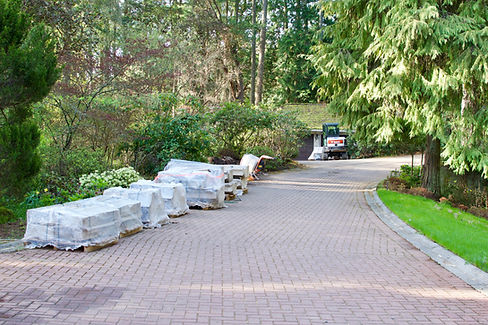
The limestone pieces were carefully inventoried and laid out in front of their intended spots. Missing sections in the arches and rounded window were recreated from spare material, shaped by hand using traditional stone-cutting techniques to match the original profiles, textures, and patina.
3. Doorway Rebuilds
The doorways were the heaviest components. Using cranes and multiple heavy-duty straps, each piece from base to capstone was lifted into position. Lime mortar provided a level bedding surface, while the crane held elements steady during curing. Accurate measurements and steady crane operation were critical to avoid misalignment or damage.
4. Archway Assembly
The arches proved more labor-intensive. Placed by hand and temporarily braced, they required extensive steel reinforcements, including strapping along the sides into the concrete wall behind, plus custom buttresses at pressure points. The lime mortar ensured a level joint but offered limited structural hold, so stability relied on the hidden steel framework.
5. Rounded Window Reconstruction
The most intricate element was the rounded window. Pieces were aligned from the base and built upward from the center outward to support the upper sides, then encased in a custom steel plate and strap system screwed into place. This preserved the original form while ensuring long-term upright stability.
6. Finishing and Safety
All joints were tooled and cleaned, and the structures were made safe for children to play near while maintaining an authentic, buttress-free appearance. The goal was longevity, ensuring these relics would stand for generations without visible modern intrusions.
The entire process was both challenging and deeply rewarding, blending historical reverence with practical innovation
Lasting Impact & Lessons Learned
The restored limestone features now serve as striking garden focal points at the Oldfield Estate, harmonizing with the renovated Maclure mansion and sprawling grounds. The project preserved irreplaceable 17th-century craftsmanship while demonstrating how heritage restoration can enhance modern living spaces.
For Stone & Trowel and Lennox Masonry, this commission was a milestone. It deepened appreciation for ancient stonemasons, sharpened technical skill in handling priceless materials, and reinforced the value of careful collaboration between consulting and execution. It also showed how important it is to respect history while making practical decisions that support long-term durability.
The owners were thrilled with the outcome: the garden gained timeless elegance, and the estate’s heritage value was elevated. The project also highlighted how thoughtful restoration can save significant costs through careful planning and better decision-making, while achieving superior longevity.
If you’re considering a similar heritage restoration in Greater Victoria, Vancouver Island, or Vancouver BC—whether rebuilding stone features, repointing historic masonry, or integrating antique elements—contact Stone & Trowel for a consultation. We bring the same dedication, research, and technical care to every project.

If you’re considering a similar heritage restoration in Greater Victoria, Vancouver Island, or Vancouver BC—whether rebuilding stone features, repointing historic masonry, or integrating antique elements—contact Stone & Trowel for a consultation. We bring the same dedication, research, and level of detail to every consulting project.
Request A Consultation
In need of an assessment when it comes to your heritage masonry project? Fill out the contact form below and we'll be in touch as soon as possible.
Contact us for a consultation or explore our heritage assessment services.