.jpg)


Duncan City Hall Restoration:
Reviving a 1913 Heritage Landmark in the Cowichan Valley
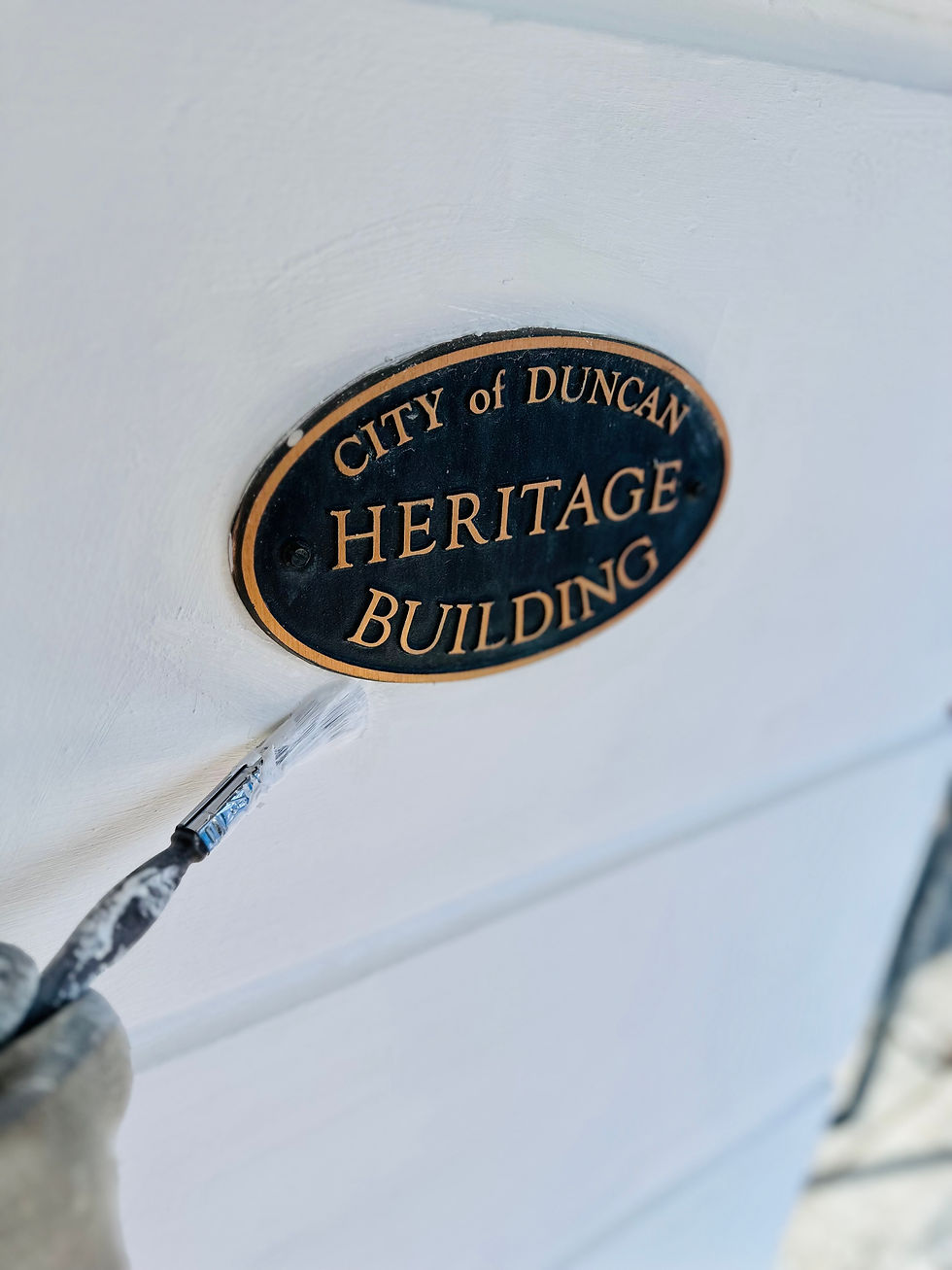
The Duncan City Hall restoration is one of the most significant heritage masonry projects in Stone & Trowel’s portfolio. Originally built in 1913 as a federal building and post office, the sandstone and brick structure at Kenneth and Craig Streets has served the Cowichan Valley for more than a century. After being saved from demolition and adapted for municipal use in the 1970s, the building remained an important civic landmark — but by the 2020s, its masonry had begun to show the effects of long-term weather exposure, moisture infiltration, biological growth, and deteriorated mortar.
In 2024, Stone & Trowel was engaged to provide the heritage consulting, assessment, and restoration direction for the project, while Lennox Masonry carried out the physical masonry work. The restoration focused on removing lead-based paint, repointing damaged joints with compatible lime mortar, cleaning the masonry with gentle methods, and protecting the building’s historic character while improving its long-term durability.

The Historic Significance of Duncan's City Hall
Duncan City Hall’s story begins in the early 20th century, during a period of rapid growth in the Cowichan Valley. Established in 1912 as a city, Duncan quickly became a commercial and administrative center for the region’s logging, farming, and Indigenous communities. The building at 202-206 Kenneth Street was erected in 1913 as the Dominion Building—a federal post office and customs house—designed in a restrained Edwardian Classical style typical of government architecture at the time. Constructed from local sandstone quarried in the nearby Cowichan area and accented with red brick, it featured a prominent clocktower, arched windows, and sturdy granite elements, reflecting the era’s emphasis on durability and civic pride.
The structure served as Duncan’s post office until 1958, when it was decommissioned amid post-war modernization. Interestingly, remnants of its original function persist today, including bank vaults in the basement that once secured federal assets. By the 1960s, the building sat vacant and deteriorating, a victim of urban neglect in a city grappling with economic shifts from resource-based industries to tourism and services. In 1974, under the leadership of Mayor Ken Paskin, a community-driven effort saved it from demolition. Recognizing its architectural and historical value, the City of Duncan acquired the property and converted it into City Hall, adapting the interior for administrative offices while preserving the exterior facade.
This adaptive reuse aligned with broader heritage movements in BC during the 1970s, influenced by the Heritage Conservation Act (enacted in 1977) and growing awareness of cultural preservation. The building was formally designated as a municipal heritage site, protecting its sandstone belts, clocktower, and arched sills under local bylaws. Over the decades, it has symbolized Duncan’s resilience—surviving economic downturns, natural wear, and even seismic risks in a region prone to earthquakes.
Architecturally, the hall exemplifies early 20th-century public building design: its sandstone facade provides a warm, textured aesthetic, while the brickwork adds contrast and strength. The clocktower, a landmark visible from downtown Duncan, serves as a functional timepiece and a nod to the city’s railway heritage (Duncan was once a key stop on the Esquimalt & Nanaimo Railway). As one of the few remaining heritage masonry structures in Duncan—amid a landscape dotted with modern developments—it stands as a bridge between the Cowichan people’s millennia-old presence in the valley and the settler history that shaped the city.
By the 2020s, however, the building showed signs of age: lead-based paint flaking from sandstone elements, eroded mortar joints allowing water intrusion, efflorescence staining the brickwork, and biological growth (moss, algae) thriving in the valley’s humid climate. These issues not only detracted from its visual appeal but also posed structural risks, prompting the City of Duncan to seek expert intervention under heritage guidelines.
The Vision: Honoring History While Ensuring Longevity
The vision for the Duncan City Hall restoration was to revitalize the building’s masonry components without altering its historic character, ensuring it remains a vibrant civic center for the next century. As a designated heritage site under the Heritage Conservation Act and local Duncan bylaws, the project needed to prioritize minimal intervention, reversible techniques, and materials compatible with the 1913 originals. The goal was twofold: address immediate deterioration (paint removal, repointing) and enhance resilience against Cowichan Valley’s environmental stressors—high rainfall (over 1,200 mm annually), salt from nearby coastal influences, and temperature fluctuations that exacerbate mortar breakdown.
Stone & Trowel (consulting) and Lennox Masonry (masonry contractor) were selected for our proven track record in heritage restorations, including high-profile sites like Government House in Victoria and the Oldfield Estate in Saanich. The City of Duncan aimed for a cost-effective approach that qualified for grants, leveraging programs from Heritage BC, provincial heritage branches, and federal Historic Places Initiative (HPI) funding through Parks Canada. By using sustainable methods like lime mortar and lime-wash, the project also aligned with BC’s climate resilience initiatives, protecting the structure from increased storm intensity due to climate change.
Ultimately, the vision was to make the building “structurally sound” while preserving its original craftsmanship—transforming a neglected facade into a source of community pride that supports Duncan’s tourism economy (e.g., as part of historic walking tours) and daily municipal operations.


Consulting Approach
Stone & Trowel’s role centered on the heritage side of the project: evaluating the condition of the masonry, identifying the most appropriate cleaning and repointing methods, and helping guide the work so the restoration would respect both the building’s age and its public significance. The project required a careful balance between technical repair and historic sensitivity, which is exactly where consulting adds the most value.
That meant looking closely at the original masonry, understanding how the building had weathered over time, and selecting solutions that would support long-term performance without introducing incompatible materials. On a structure like Duncan City Hall, every choice matters — from how deeply mortar is removed, to how cleaning is done, to what kind of finish is used at the end. Stone & Trowel’s consulting direction was intended to make those decisions with the building’s future in mind.
Lennox Masonry's Role
Once the restoration plan was established, Lennox Masonry carried out the hands-on masonry work on site. Their team handled the repointing, surface repairs, and restoration tasks required to bring the building back into stronger condition. Working on a heritage building of this scale required precision, restraint, and a strong understanding of traditional masonry practices.
The physical work included removing deteriorated mortar, preparing joints, matching compatible lime-based mortar, and carefully repairing the stone and brick elements without compromising the historic fabric. Lennox Masonry’s role was to execute the restoration in the field, while Stone & Trowel provided the consulting framework that guided the project. Together, the two roles supported a result that was both technically sound and respectful of the building’s heritage character.
Lead Paint Removal and Cleaning
One of the first major tasks was removing the lead-based paint from the sandstone elements. This required controlled methods that would protect both the masonry and the workers handling the removal. Because the sandstone is porous and relatively delicate, aggressive stripping methods would have risked damage, so the work needed to proceed carefully and methodically.
After the paint removal, the exterior was gently cleaned to remove moss, algae, grime, and other surface buildup. Low-impact cleaning methods were used to avoid eroding the stone or altering its historic appearance. The goal was to restore clarity to the masonry surface while preserving the texture and character that make the building visually distinctive.
Repointing and Masonry Repair
With the surfaces prepared, the repointing work became the heart of the project. Deteriorated mortar was removed from the joints and replaced with a traditional lime-based mortar selected for compatibility with the original 1913 masonry. This kind of mortar is especially important in older buildings because it allows the wall to breathe and helps manage moisture more effectively than modern cement-rich mixes.
The repointing restored stability to the sandstone and brickwork while also improving the building’s resistance to future water intrusion. Where needed, repairs were blended carefully so the work would sit naturally within the existing masonry rather than standing out as a modern addition. The result was a stronger, more durable exterior that still reads as a historic civic building.
Project Outcome
The completed restoration helped revive a landmark that plays an important role in Duncan’s civic and architectural identity. The building now presents a cleaner, more stable, and more dignified appearance, while the underlying masonry has been brought into better condition for the long term.
For Stone & Trowel, the project reflects the value of a consulting-led restoration approach. Careful assessment came first, followed by appropriate material selection and hands-on workmanship. Lennox Masonry’s execution made the physical restoration possible, while Stone & Trowel’s consulting role helped ensure the work aligned with heritage best practices.
If you’re considering a heritage masonry project in Duncan, the Cowichan Valley, or elsewhere on Vancouver Island, Stone & Trowel provides independent consulting, restoration planning, and technical guidance for historic buildings.

If your heritage property in the Cowichan Valley, Greater Victoria, or Vancouver Island requires chimney inspection, repointing, or full masonry restoration, contact Stone & Trowel for a consultation. Let’s protect your legacy together.
Request A Consultation
In need of an assessment when it comes to your heritage masonry project? Fill out the contact form below and we'll be in touch as soon as possible.
Contact us for a consultation or explore our heritage restoration services.