.jpg)
Restoring the Porte Cochere at Government House: A Personal Look at Preserving One of Victoria’s Most Iconic Entrances


When the call came to work on Government House, I felt that mix of excitement and responsibility you only get with truly special projects. The Porte Cochere — that grand sandstone and granite carriage entrance — has stood at the heart of Victoria’s historic Rockland neighborhood for more than 130 years. It’s welcomed governors, dignitaries, and generations of visitors, survived two fires that destroyed earlier versions of the residence, and remains one of the few continuous architectural elements across three incarnations of the Government House.
But time and Vancouver Island’s weather had taken their toll. Moss, lichen, and algae blanketed much of the stone. Salt air and strong winds had driven moisture deep into the joints causing efflorescence. Old mortar had eroded or been patched with incompatible materials, letting water seep in during our heavy winter rains. Left unchecked, those issues could have led to spalling, cracking, and even structural risk on a site this significant.
Here at Stone & Trowel, we were honored to be trusted with the restoration. Our goal was simple but demanding: bring the Porte Cochere back to its original beauty and strength without changing what makes it historic — and do it in a way that would stand up to another century of coastal weather.

Starting with Respect: Assessment & Permits
Before any tool touched the stone, we did our homework. Government House is a provincially designated heritage site, so every step had to comply with the Heritage Conservation Act and City of Victoria bylaws. We conducted a full heritage impact assessment, checked the BC Heritage Registry, and secured the necessary Heritage Alteration Permit. Lab tests on the original mortar confirmed it was lime-based — breathable and flexible — which guided everything we did next.
We also documented the existing condition thoroughly: photos from every angle, notes on joint depths, efflorescence patterns, and biological coverage. This record was essential for compliance reporting and later helped secure heritage grant funding.
Gentle Cleaning: Bringing the Stone Back to Life
The first phase was cleaning — and this is where the DOFF Integra steam system really shines. We used superheated steam at low pressure to lift away decades of moss, lichen, algae, and urban grime without chemicals or abrasion. The 150°C vapor softens contaminants so they release easily, and the minimal water volume (about 5 liters per minute) means the stone dries quickly — crucial in Victoria’s humid winters to avoid mold regrowth or freeze-thaw damage.
Working at height on scaffolding, we cleaned section by section, top to bottom, so runoff didn’t re-soil lower areas. The DOFF Recovery System vacuumed waste water and debris, keeping the grounds clean and protecting the estate’s landscaping. Watching the sandstone emerge — warm, textured, and alive again — was one of those moments that reminds me why we do this work.

Repointing: Matching History, Ensuring the Future
With the surfaces clean, we moved to repointing. Many joints had eroded to 1–2 inches deep, some filled with rigid modern cement that had trapped moisture and accelerated cracking. We carefully raked out the old mortar using hand tools and low-vibration pneumatic chisels to avoid damaging the soft sandstone.
For the new mortar, we mixed a custom Hotlime formulation — slaked from Quicklime with local aggregates to match the original color and texture. Lime mortar is breathable and flexible, allowing moisture to escape rather than stay trapped behind the stone. We applied it in layers, tooled the joints to replicate the historic concave profile (better for shedding water), and brushed the finish for a seamless look.
We also addressed minor flashing and crown issues with stainless steel inserts (rust-resistant for coastal air) and subtle helical ties where needed — all reversible and hidden to preserve the original appearance.
The Reward: A Landmark Ready for Another Century
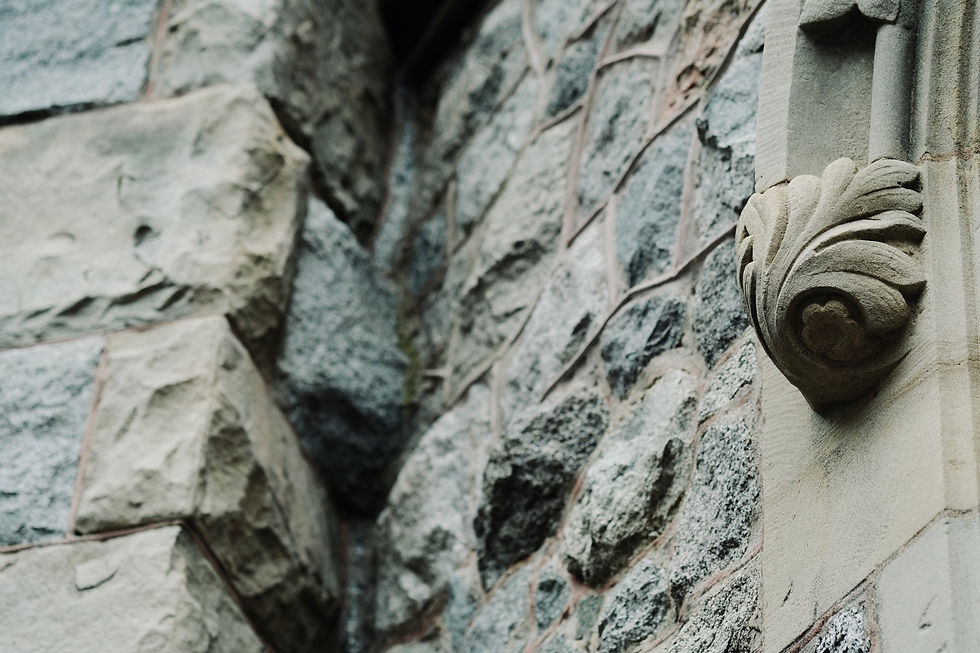
When the scaffolding came down, the Porte Cochere looked like it had just been built — vibrant sandstone glowing, joints crisp and secure, the whole structure weather-ready once again. It was deeply satisfying to know this entrance would continue welcoming people to Government House for public events, garden tours, and official ceremonies.
The project also qualified for heritage grant funding, which helped offset costs — a reminder that preservation can be both meaningful and financially smart. For us at Stone & Trowel, it reinforced why we specialize in heritage work: every restored stone, every cleaned surface, keeps a piece of Victoria’s story alive.

Have a Heritage Project in Mind?
Restoring Government House was a highlight, but we bring the same care, research, and craftsmanship to every home, church, and public building we touch. If your heritage property in Greater Victoria or Vancouver Island needs repointing, chimney work, DOFF cleaning, or a full masonry restoration, we’d love to help.
Read more about the techniques we used:
Contact us for a free assessment — let’s protect your piece of history together


Comments